
Fare evasion is a challenge that nearly every public transit agency and transport operator faces. While it is tempting to treat enforcement as the primary solution, long-term revenue protection depends on a wider set of levers.
Protecting revenue and ensuring fairness requires more than barriers and citations. It starts with understanding why non-payment happens, recognizing that not all fare evasion is the same, and then applying a mix of rider focused design, equitable access, operational discipline, and targeted enforcement.
At Masabi, we believe modern fare payment systems delivered as Software as a Service, combined with better rider experience and data driven operations, can help agencies reduce fare evasion while building trust and improving equity.
What is fare evasion and why does it happen?
Fare evasion is traveling without paying the correct fare. In practice, it can include not validating a ticket correctly, using an incorrect product, exploiting a system gap, or committing deliberate fraud.
It helps to be clear about one more thing: fare evasion is only one part of revenue protection. Agencies also lose revenue when the payment experience is confusing, when devices are out of service, when rules are unclear, or when fraud controls are not strong enough.
Why it happens usually comes down to a few root drivers that agencies and authorities can influence:
-
Friction and confusion: Fare structures, zones, validators, and product rules can be hard to understand, especially for visitors and occasional riders.
-
Affordability and access: Some riders cannot afford the full fare or cannot easily access reduced fare programs that exist for them.
-
Opportunity and social norms: When non payment feels easy or consequence free, it spreads. People notice what others do.
-
Operational gaps: Broken or offline validators, unclear signage, and inconsistent inspection patterns can turn willing payers into accidental non-payers.
Common patterns of fare evasion
Agencies often treat fare evasion as binary: you paid, or you did not. In reality, it spans a spectrum of behaviors and vulnerabilities. These five patterns show up across many networks.
1. Unintentional non-payment
Riders get confused by fare products, zone or fare validity rules, tap on or tap off requirements, or ticket machines. This also includes riders who try to pay but cannot because a validator or ticket machine is not working or a top up or payment option is unavailable in the moment. The intent is not malicious, but the experience can still lead to revenue loss and frustration as well as anxiety for Riders.
2. Opportunity driven non payment
These riders would usually pay, but can be enticed to skip payment when the environment makes it feel safe or acceptable to do so. Examples include open gates, rear door boarding with no reminder, or a belief that checks are unlikely. This is where social proof matters most: visible non payment can quickly become normalized as being socially acceptable.
3. Economically constrained non payment
Some riders rely on transit to get to work, care for family, or access services, but cannot always afford the fare. If discounted programs are hard to discover or difficult to enroll in, riders may choose between missing essential trips or riding without paying.
4. Repeat evasion
These are riders who intentionally look for ways around payment, such as tailgating, misusing products, or exploiting gaps in station design or validation rules. Some justify it as a response to poor service, but the behavior still harms system sustainability.
5. Deliberate fraud
This includes counterfeiting, stolen credentials, account abuse, or coordinated manipulation. The number of offenders may be small, but the impact can be significant, especially if weaknesses undermine confidence in the wider payment system.
The Importance of Fare Enforcement Visibility
When fare evasion becomes visible, it stops being an isolated behavior and starts reshaping rider expectations. If people regularly see gates being hopped or riders boarding without validating, even riders who would normally pay can begin to question why they should be the only ones following the rules. Over time, that sense of unfairness can erode trust and weaken the social norm of paying, creating a ripple effect where non payment feels more acceptable and more common than it actually is.
This is one reason agencies cannot ignore fare evasion, especially the intentional and malicious patterns that are easiest to spot and most likely to spread. Left unaddressed, visible evasion tends to grow because it changes what riders believe is normal and what they believe the system will enforce. The goal is not to create a punitive environment, but to respond quickly and consistently so paying remains the default, fairness is protected, and occasional non payment does not become an expectation.
A practical revenue protection playbook for transit agencies
The most effective programs treat fare evasion holistically as a design and operations challenge, not only a policing and enforcement problem. Here are the building blocks agencies can use to reduce non payment while protecting the rider experience.
Start with measurement and shared definitions
Before changing policy, staffing, or technology, agencies need a baseline they trust. That baseline should be specific enough to guide action, not just describe the problem.
A practical starting point is to segment by mode and location, then validate the story with multiple inputs such as validation rates, passenger counts, inspection frequency, and rider feedback. Keep the focus on trends and hotspots rather than chasing perfect precision, and seek to identify and address the biggest causes iteratively, rather than every cause from day-one.
Masabi Tip: Account based systems make it easier to connect validations, entitlements, and payment activity in the back office, so teams can see where leakage occurs and test whether changes are working.
Make paying easy, fast, and forgiving
In most systems, the biggest wins come from reducing friction. When payment is simple and intuitive, more people do it. Ideally, it should be easier for a rider to pay for a fare than evading it.
Agencies typically get the most impact from a combination of fare policy simplification and modern payment experiences:
- Reduce decision making at the point of travel with fare capping or best fare approaches where the system calculates the right fare based on actual usage.
- Make both fare structures and fare payment options simple, clear and consistent across the transit network.
- Use account based ticketing so riders can tap with a credential and let the back office handle rules and pricing.
- Design clear, consistent validation processes so riders always know what to do, even across different modes.
Masabi Tip: Account Based Ticketing helps riders avoid guesswork and reduces accidental and opportunity driven non payment. Justride supports account based approaches across open loop EMV and closed loop credentials from a single back office.
Offer payment options that match real life rider needs
A revenue protection strategy is only as strong as its accessibility. If paying requires the right phone, the right card, particular payment methods or the right retail location, some riders will be excluded.
Instead of trying to force one method for everyone, successful agencies support a small set of complementary options that cover their rider base. That usually includes a bank card or mobile wallet path, a closed loop option for riders who prefer it, and convenient ways to top up for cash reliant riders.
Masabi Tip: Supporting multiple fare media types from one platform helps agencies serve different rider groups without creating a fragmented operational model.
Make reduced fare access simple, visible, and dignified
Affordability driven evasion cannot be solved with gates alone. It is reduced when agencies make it straightforward to find the right fare and easy to enroll.
The operational goal is to remove barriers to riders obtaining any reduced fare they are eligible for while maintaining auditability and minimising misuse. Many agencies are moving toward online enrollment, digital verification, and account linked entitlements so discounts are applied automatically when eligible riders travel.
Masabi Tip: Secure entitlement linking in an account based environment helps agencies apply concessions consistently across channels while keeping eligibility and audit controls in place.
Build a culture of compliance with clear communication and consistent presence
Education and engagement are most effective when they feel respectful, practical, and tied to service quality. The goal is to reinforce the idea that paying is normal, expected, and linked to better service.
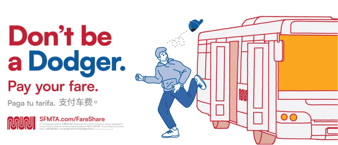
Best Practice: Campaigns that frame payment as supporting the service, rather than threatening riders, can help reset norms. SFMTA’s “Don’t be a Dodger. Pay your fare.” campaign is one example of a playful, rider facing message tied to keeping service moving. SFMTA
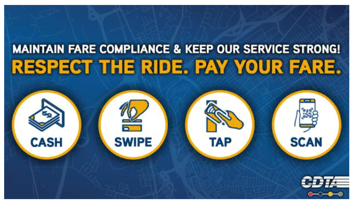
Best Practice: CDTA’s “Respect the Ride. Pay your Fare.” campaign is another example of positioning fare compliance as community fairness, paired with signage and announcements. cdta.org
A practical addition here is service recovery. If validators are down or rules are temporarily changed, agencies should clearly tell riders what to do. Ambiguity turns willing riders into accidental violators.
Use data to focus enforcement and strengthen fraud defenses
Enforcement still matters, especially for repeat evasion and deliberate fraud. The difference is how it is applied.
Effective programs prioritize targeted, predictable operations over sporadic crackdowns. They also treat fraud prevention as a system design requirement, not an afterthought. That includes strong ticket security, clear inspection workflows, and analytics that identify suspicious patterns without creating a hostile experience for everyday riders. On the contrary, everyday riders are likely to feel reassured by regular inspections as it demonstrates that the system is fair and everyone is paying what they should to travel, just like them.
Masabi Tip: Platforms that support real time data, device health monitoring, and integrations with inspection tools help agencies focus resources where they will have the most impact.
Keep infrastructure welcoming, while reducing obvious vulnerabilities
Station and vehicle design can deter certain behaviors, but it should not come at the cost of accessibility or comfort. The goal is not to create a fortress. The goal is to remove easy loopholes, improve clarity, and maintain flow, throughput and accessibility.
Best Practice: Focus first on clarity and usability, then address physical vulnerabilities in a targeted way. Clear indicators, intuitive tap zones, and reliable validators can reduce tailgating and passive non payment without escalating the environment.
Final thoughts: reducing evasion by designing better systems
Fare evasion is not a fixed trait. It is often a symptom of friction, affordability challenges, confusion, or opportunity. That is why enforcement alone, especially if sporadic or irregularly conducted, rarely delivers sustainable results.
Agencies tend to see the strongest improvements when they combine three things: make it easy to pay, make it possible for everyone to pay, and use data to target repeat evasion and deliberate fraud.
That is exactly what we help our partners achieve with Masabi’s Justride platform: a flexible SaaS solution that supports modern fare collection, improves the rider experience, and strengthens revenue protection.
Want to make fare payment simpler, smarter, and more inclusive?
Let’s talk about how Masabi can help you protect revenue while supporting the riders your system serves.